

How to Smartly Invest in Startups with evalyze.ai
Finding the right opportunities when investing in startups can be challenging. Evalyze.ai is here to make it easier.
December 2, 2024
Learn how to structure a pitch deck story investors can follow, connect each slide logically, and strengthen your pre-seed or seed fundraising narrative.
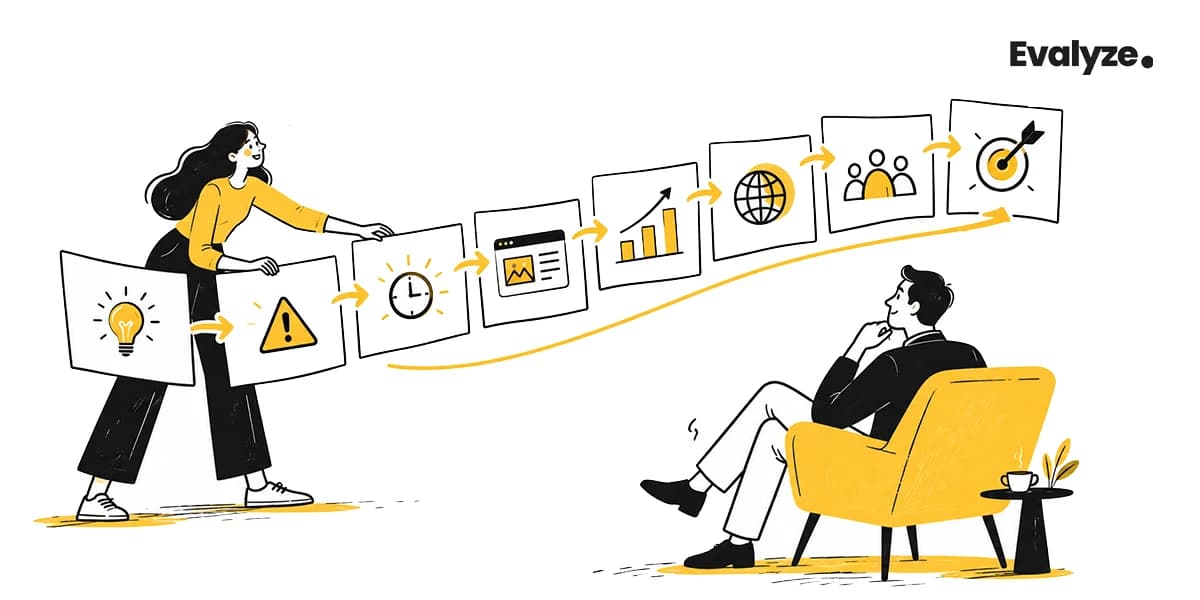
Pitch deck storytelling is the process of turning separate slides about your problem, product, traction, market, team, and raise into one logical investment case.
A strong pitch deck story lets an investor understand what your company does, why the opportunity exists, what evidence supports it, and what the next round of capital is meant to accomplish.
That matters because investors rarely study a first deck like a business plan.
Dropbox DocSend states that VCs spend an average of 3 minutes and 44 seconds reviewing seed decks, and that only 58% of pitch decks are viewed to completion. That limited attention makes clarity and logical slide progression especially important.
Key Takeaways
Pitch deck storytelling is the logical sequencing of your startup's investment case.
It does not require a dramatic founder story, a hero-villain metaphor, or a cinematic opening. For most pre-seed and seed decks, the more useful goal is simpler:
Make each slide answer one investor question, support the answer with evidence, and create a clear reason to continue to the next slide.
A deck with all the standard pitch deck sections can still have a weak story. Problem, solution, market, traction, team, and ask may all be present, but if the relationship between them is unclear, the investor has to assemble the argument on your behalf.
A good pitch deck narrative removes that work.
A startup pitch deck should explain why this company, in this market, with this team, has a credible opportunity to create significant value and why the proposed round is a sensible next step.
The investor needs to resolve a series of questions:
| Investor question | What your deck needs to establish |
|---|---|
| What does the company do? | A clear, specific description of the company |
| What problem exists? | A real customer or market problem worth solving |
| Why now? | The change that makes the timing relevant, if one exists |
| Why this approach? | How the product addresses the stated problem |
| What proof exists? | Traction or other stage-appropriate evidence |
| Can this become a meaningful business? | Market, business model, distribution, and competitive position |
| Why this team? | Relevant ability to execute |
| Why raise this round? | The amount, purpose, and milestones tied to the capital |
Sequoia Capital's pitching guidance follows similar investor logic: company purpose, problem, solution, why now, market potential, competition, business model, team, financials, and vision. Sequoia also notes that what stood out in Airbnb's early pitch was the founders' ideas and clarity of thinking rather than the slides themselves.
A review of more than 20,000 pitch decks points to a similar set of building blocks, while also showing that there is no single correct slide order. The sequence should make sense for the company's story.
A template gives you sections. Storytelling determines how those sections connect.
Use this as a default sequence, then change it when your strongest evidence belongs somewhere else.
Your first slide should make the company understandable.
A descriptive one-liner is usually more useful than a mission statement that could apply to several companies. An investor should not need the next three slides to work out what category you are in.
Weak headline
The future of workforce intelligence
Stronger headline
ShiftBridge automatically rebuilds hospital staffing plans after last-minute schedule changes.
The example above uses a hypothetical startup.
The stronger version identifies the customer, the job being done, and the product's role. It also creates the next question: why is rebuilding hospital staffing plans a problem worth solving?
For an early-stage company description, use plain, descriptive language that tells an investor what the startup actually does.
The problem slide should establish a specific pain, inefficiency, risk, or missed opportunity.
Do not begin with a broad statement if your product solves a narrower operational problem.
Weak headline
Healthcare staffing is inefficient
Stronger headline
When a shift changes at short notice, staffing teams have to rebuild coverage across availability, skills, and scheduling constraints.
The body of the slide should then prove that statement using your real customer research, operating data, or a credible external source.
If you cannot support the problem with evidence, the issue is not the wording. The claim itself needs more work.
A Why Now slide explains what changed.
The change may be technological, regulatory, economic, behavioral, or specific to the market. Use this section when there is a real shift that explains why the startup is more viable, relevant, or necessary now.
Do not force it. If the timing argument is weak, leave the slide out.
A credible Why Now slide answers a counterfactual question:
Why would this company have been harder, less useful, or less viable several years ago?
Use evidence for the shift. A statement such as "AI is changing everything" does not explain timing. Name the specific capability, cost change, regulation, infrastructure change, or customer behavior that matters to your company.
Your solution should resolve the problem you already established. Founders often lose narrative continuity here because the deck suddenly switches from the customer's problem to a product feature list. Explain the mechanism first.
Example
Problem
Staffing plans become outdated after a last-minute change.
Solution
The product recalculates viable coverage using the hospital's staffing rules and employee availability.
Now the solution follows directly from the problem.
A feature such as "AI scheduling assistant" is secondary. The investor first needs to understand what changes for the customer.
Traction changes the deck from an explanation of a possibility into evidence about a real company. The evidence should fit your stage.
A pre-seed company may have a prototype, design partners, pilots, letters of intent, customer interviews, early product usage, or initial revenue. A seed company should normally have stronger operating evidence appropriate to its business and stage.
The right evidence also depends on which startup metrics you include in your pitch deck, since usage, revenue, retention, unit economics, and market evidence do not carry the same weight for every business model.
Depending on the stage, traction can include customers, customer feedback, letters of intent, pilot results, product usage, or other external validation rather than revenue alone. Do not hide your strongest proof near the end simply because a template puts traction there. If traction is your strongest reason to believe the company is working, move it earlier.
A chart titled:
Monthly Active Users
reports data.
A title such as:
[Verified growth rate] growth came primarily from repeat use by hospital staffing teams
makes a claim about what the data means.
Use the stronger form only when your data supports it.
A large market slide does not answer this question on its own.
Your pitch needs to show how the startup participates in that market: who pays, how the company makes money, how it reaches customers, what alternatives exist, and why customers would choose this approach.
These sections do not have to sit together, but they should support the same argument.
Avoid a competition slide designed so your company wins every row. Investors can research competitors independently.
A useful competition slide shows that you understand what customers compare before they buy.
A team slide should explain team-market fit rather than reproduce LinkedIn profiles.
Relevant experience matters when it answers:
Why is this team equipped to solve this particular problem?
A founder who has worked directly in the industry or managed the problem before has a stronger connection to the opportunity than a list of prestigious but unrelated company logos.
Replace a generic "Team" title with a headline that states the team's relevant advantage.
Example
Weak headline
Our experienced team
Stronger headline
Built by operators with direct experience in hospital scheduling and healthcare software.
Use that form only when it is factually true.
The fundraising ask should connect back to the story you have already told.
State how much you are raising and what milestones the capital is intended to reach.
A useful funding slide can include the round size and objectives, along with information such as committed capital, use of proceeds, financing instrument, or runway when relevant.
A generic use-of-funds chart such as:
40% product
30% marketing
30% hiring
tells the investor where the money goes. It does not explain what the round changes.
A stronger framing connects spending to company progress:
We are raising [verified amount] to reach [verified product, revenue, regulatory, or customer milestones] over [verified period].
Do not invent milestone precision to make the slide appear more sophisticated. The milestones should come from the operating plan.
Test every slide against three questions:
Suppose your problem slide establishes that hospital staffing teams cannot update coverage efficiently after schedule changes.
The natural next question is: How do you solve that?
If the next slide suddenly discusses the total healthcare software market, the narrative breaks. The market information may belong in the deck, but it appears before the investor has enough context to value it.
There is another useful test: read only the slide headlines in order.
If the headlines do not form a coherent argument, redesigning the slides will not fix the underlying problem.
This is why section labels such as "Problem," "Solution," "Traction," and "Market" are weak narrative devices. They identify the type of slide but make no claim.
Prefer headlines that tell the investor what matters.
Consider the hypothetical ShiftBridge startup.
A template-first pitch might use these titles:
All expected sections are present, but the titles tell the reader almost nothing.
A story-led version could read:
The second version turns section labels into an argument. The bracketed sections are intentional. Strong writing cannot compensate for missing evidence.
If you do not yet know the market entry point, pricing model, acquisition channel, or milestones, the deck has exposed a strategy question that needs to be answered outside the slide editor.
If you want to compare this framework with real fundraising materials, review these recently funded startup pitch decks and look at how their claims, evidence, and slide order differ by company.
No. Use a default structure until you have a specific reason to change it.
The slide order should support the company's story rather than follow one fixed sequence. Different pitch deck frameworks use different structures while still covering many of the same underlying investment questions.
Some situations justify changing the order:
| Startup situation | Reason to adjust the order |
|---|---|
| Seed startup with unusually strong traction | Move proof earlier because it changes how the rest of the opportunity is interpreted |
| Deep-tech startup | Explain the enabling technical shift before asking the investor to evaluate the product |
| Marketplace | Use one side as the primary narrative, then introduce the second side where it becomes necessary |
| Pre-seed startup with little operating data | Spend more time establishing the problem, insight, timing, and team; do not manufacture traction |
For a multi-sided marketplace, keeping one side as the primary narrative can make the deck easier to follow than splitting every slide between both sides.
Change the order when it improves comprehension. Moving slides around only to look different rarely does.
A pre-seed story carries more uncertainty, so the deck usually needs to make the founder's insight and early evidence easier to assess. At seed, the narrative should generally contain more evidence that the company can execute.
| Area | Pre-seed emphasis | Seed emphasis |
|---|---|---|
| Problem | Depth of customer insight | Evidence that the problem can support a repeatable business |
| Product | Credible approach, prototype, or early product | Product usage and evidence of customer value |
| Traction | Early external validation appropriate to stage | Stronger operating metrics appropriate to the business |
| Go-to-market | Initial hypothesis and reachable customer | Evidence that acquisition channels can work |
| Team | Founder-market fit and ability to build | Ability to sell, operate, hire, and expand the model |
| Ask | Milestones that reduce major early risks | Milestones that strengthen growth and prepare for the next financing stage |
Earlier-stage startups can rely on forms of traction such as pilots, letters of intent, customer feedback, or early product usage, while seed-stage companies are generally expected to provide stronger operating evidence and execution signals.
The specific evidence still varies by company. A B2B SaaS startup, biotech company, consumer app, and marketplace should not be forced into the same metrics.
A short origin story can be useful when it explains unique insight or founder-market fit.
If investors still do not know what the company does after several slides, the origin story is taking too much space.
A clear narrative may make the deck easier to understand and remember. Material business claims still need support.
Source market data. Label assumptions. Use your actual operating metrics.
A product is harder to evaluate if the investor does not yet understand the job it performs or why the existing alternative falls short.
A large category does not show that your company can reach customers, win against alternatives, or build an attractive business model.
If one metric, customer behavior, technical milestone, or team advantage changes how the company should be understood, do not bury it simply to follow a template.
"Market Opportunity" tells the investor what type of slide they are looking at.
It does not tell them what you learned about the market.
The final slides should show what the round enables.
If the milestones do not follow from the strategy explained earlier, the fundraising ask will feel arbitrary.
Before sending your deck, review it once for narrative rather than design.
Before sending your deck, review two things: story and evidence.
Read the slide headlines in order. Each one should make a clear claim and lead naturally to the next. Then check every number, market statement, customer claim, competitive claim, and projection against verified company data, a credible source, or a clearly labeled assumption.
Evalyze is AI that runs your fundraising.
Upload your deck to Evalyze AI Pitch Coach to review its structure, narrative, and individual slides. You can also see how Evalyze reviews a pitch deck before using it.
From there, the workflow continues beyond the deck. Use Startup Analyzer to assess investor readiness, then find and evaluate matched investors, build your shortlist, prepare outreach, and manage the raise from one workflow.
Start Your Fundraising
FAQ
Finding the right opportunities when investing in startups can be challenging. Evalyze.ai is here to make it easier.
December 2, 2024

From pitch perfection to investor follow-ups, here's how Evalyze.ai uses AI to accelerate your fundraising journey.
July 1, 2025